Sunday, March 31, 2013
Spring Break
I spent most of the last week enjoying warm sun and red sandstone in beautiful southeastern Utah. I didn't think about fish much at all. Therefore, I don't have a post prepared for this week. I'll be back next week. In the meantime, give me some ideas - what do you want to see me write about?

Sunday, March 24, 2013
Fraser River: Kaibab Park
The third and final installment of our discussion of the Fraser will highlight Kaibab Park, in the town of Granby. This is the public reach of river adjacent to the baseball fields. I've been surveying a 650-foot reach of river there since 2009. The upstream terminus of the station is the town's big rock diversion structure immediately downstream of the Highway 40 bridge.
The adult trout habitat on this reach is not great, and this portion of the river definitely experiences low flow/high temperature issues in late summer some years. There is not much of a rainbow component here, so the whole story of this reach is what's going on with the browns. Below are the population estimates for the four years I've electrofished it.

Things were pretty consistent here until 2012, when a couple population parameters went somewhat haywire. First of all, the density of quality dish plummeted. I think that this has to be a response to drought conditions in 2012. During the periods of time last summer when there was as little as 17 CFS of water being recorded at the Northern gauge, it didn't take an expert to look at the stream and quickly determine that there was very little adult trout habitat available. There are some private reaches downstream that are a little better off physically, with undercut banks, etc. I suspect that the larger browns moved down into that area to weather the drought conditions.
The next big difference in 2012 was the 243% increase in number of fish per mile greater than 6". To see what happened there, look at the length-frequency histograms below:
.png)
.png)
.png)
At the same time that the adult brown trout population was declining drastically, we had a huge year class show up in 2011. Normally we don't associate giant water years with strong year classes of browns, but things behaved differently in this location. Due to the fact that this reach is toward the downstream end of the river, I think what happened in 2011 is that this part of the river received fry that were displaced by the high flows from several miles of river upstream, including probably all of the canyon. That 2011 year class stuck around and we saw them again in 2012 as a big age-1 year class. The abundance of this group of fish is what caused the fish-per-mile estimate to increase so much.
The third big difference in the 2012 sample is the huge number of sculpin we picked up. This is the most dense sculpin population I've seen to date. I think the reason for this increase is the same reason that I just described above, with the small brown trout. Also, the 2012 low water in this reach probably benefitted the sculpin to the extent that there were not as many predators (in the form of adult brown trout) around.
A lot of people spend years fishing these waters and never see firsthand the species that is the most numerically common fish here. They're surprisingly elusive critters, especially when you realize how many there are in certain areas. So I'll finish up this week's post with a couple shots of sculpin - definitely one of my favorite fish.


Sunday, March 17, 2013
Fraser River: Safeway
Continuing with our discussion of the Fraser River, this week I'll share some information about what I call the Safeway station. I call it that because it's a 600-foot reach of river directly behind Safeway, in the town of Fraser.
This is on the downstream end of what was called FREP, the Fraser River Enhancement Project. The town of Fraser partnered with us, TU, and other entities to construct a stream habitat improvement project. Work on this reach was finished in 2005. This is one of my favorite stream habitat projects I've seen. The main reason is that to the untrained eye, or if you're not looking for it, it's not obvious that the stream was worked on. That's the best way for habitat projects to turn out, in my opinion.
We've got a good survey history at this site; I've electrofished it every year that I've been here, and my predecessor Bill Atkinson established the station in 2003. This has always been a fascinating reach. It represents the transitional zone where the river is changing from a (historically) brook trout-dominated montane stream above (see last week's post), to a classic brown trout stream below in the Fraser Flats. Since the completion of the habitat project, this section has held a nice mix of browns, rainbows, and brook trout. The graph below displays the biomass estimates over the years for all three species:
.png)
You can see that in 2003, prior to the habitat project, things were in really bad shape. The total trout biomass estimate, for all species combined, was 12 pounds per acre. In 2012, that estimate was 163.
The big spike in rainbow trout densities seen in 2008 is the result of me stocking Colorado River rainbow brood culls in the river. We did that for a few years right after the habitat project was done. The idea behind that was to get some rainbows in as "place holders" in the river in order to create a rainbow fishery and compete with the browns as they recolonized the reach. It wasn't intended to be a long-term thing. 2008 was the last time I stocked any of those. I had originally hoped that we might possibly see some reproduction out of those fish, but it didn't happen.
I've been stocking HXC fry in this reach since 2010, at the same time as I've stocked Confluence Park. That is the cause of the rebound in rainbow trout biomass that has occurred in 2011 and 2012. These plants have performed nicely here as well, but we haven't seen the complete takeover here that we have seen at Confluence Park.
Below are the rainbow trout size distributions for the past three years:


In 2010, we were pretty much starting out from scratch with the rainbows. The brood culls hadn't stuck around, and that year's HXC plant actually went in at 3.5", on September 13 (after this survey), so they don't show up here. In 2011, the 2010 plant was present in good numbers and appeared to have formed a nice little year class, and doubled their average length at 7". The 2011 fry plant shows up at 2", and that bar is somewhat higher than the graph. In 2012, we can see that the 2010 fish have put on another four inches and are now hitting 11" (2" larger than the same year class up at Confluence Park), and the 2011 plant grew nicely, to 8". It was a little bit disappointing that there weren't more fish in that 8" size group in 2012, suggesting that the 2011 plant had possibly experienced relatively high mortality. That's probably to be expected here, because we do see browns up to 18" or better at this site, so there is certainly more predation going on here than at Confluence Park.
Now, here are the brown trout size distributions over the same time period:
.png)
.png)
.png)
The graphs going all the way back to 2003 look very similar to the 2010 and 2011 graphs. In fact, the one concern that I have had about the habitat project is that prior to 2012, it appeared that there was very little or no successful brown trout spawning taking place - as suggested by the absence of age-0 or age-1 year classes. I thought that this was possibly a result of the habitat project representing a trade-off which sacrificed spawning and fry-rearing habitat in favor of maximizing adult holding water. However, the reach had maintained a decent adult brown trout fishery, and the theory I had to explain this was that adult brown trout migrated into this reach at a steady rate -- probably from Fraser Flats -- and stayed, because the habitat quality is high. 2012 threw me for a loop. As you might have guessed, many of those bars are cut off in order to maintain consistent axes on the three graphs. But the 3" bar actually extends up to 107, and the 7" bar extends up to 33. In other words, in 2012 this reach was just loaded with age-0 and age-1 browns, which we had never seen here before, and which seemingly appeared out of nowhere. The reason I say that is because the group at 7", which would have been born in 2011, should have showed up in large numbers in the 2011 sample at 3" or so, but they weren't there at all in 2011.
The big age-0 year class, at 3", is easy enough to explain. Low water years result in very high survival in baby brown trout. They don't have to fight a big runoff, and warm water results in higher growth rates and a longer growing season for them. But I haven't thought of any good reason for the appearance of the big age-1 group. That will probably remain a mystery.
Anyway, that's the Safeway station in a nutshell. It's a fascinating place to observe the ever-shifting dynamics of these three species and their interactions.
Sunday, March 10, 2013
Fraser River: Confluence Park
I get asked a lot about the Fraser River and the status of its fish populations. That's always a difficult question to answer, because the Fraser is an extremely dynamic stream, in which there are hardly two miles of river that resemble each other. This is a stream that undergoes many transitions in its relatively short run from its Berthoud Pass headwaters to its confluence with the Colorado at Windy Gap. To call it a river (at least in its modern state) is a little bit of a misnomer, as it's really more of a large creek. There are certainly more extreme examples in this state though -- the Swan River near Breckenridge is the one that always comes to mind.
So, I thought maybe I'd do a series of posts based around each of the electrofishing stations that I survey regularly on the Fraser. I've got two locations that I've been hitting anually, one that I get to less often than that but still regularly, and a number of places I've surveyed one time. The single-visit sites are mostly on private land and have served to fill in information gaps and give us a better big-picture overview of the Fraser. However, because those sites are on private land I won't comment on them here.
The farthest upstream station that I survey regularly is called Confluence Park, and is located in the town of Winter Park. The station is 570 feet long and the upstream end is the pool where Vasquez Creek joins the Fraser. I have electrofished that reach in 2007, 2009, and 2012. We were astounded at the changes we found on this reach in 2012.
This reach of river is still a pretty cold, montane type of a stream with a bit more gradient than what is found below. It's heavily shaded with spruce-fir and willow stands along the banks. Brown trout are rare on this reach. It's always been more of a brook trout stream, producing some fish beyond the 13" mark in recent years.
I have been telling you about the successes we have seen planting small (1.5-2") Hofer x Colorado River Rainbows (HXC) down in the mainstem Colorado. We have also been planting them in this reach of the Fraser since 2008. Obviously, we don't float a raft down in July on the Fraser to stock, like we do on the Colorado. We have been stocking them by hand in a handful of locations.
Here is the length-frequency histogram for brook trout and rainbows when we surveyed the reach in 2009:
.png)
As you can see, brook trout were the dominant trout species. Both of the size-groups of rainbows can be traced to two different plants we made in 2008, one of CRR brood culls (the larger fish) and the first batch of HXC fingerlings (the 4" fish) to be stocked. I was surprised that those HXC's were still sitting at only 4"; that is the size they had gone in 11 months before this survey, and didn't appear to have grown at all. Beginning in 2010, we shifted to the smaller HXC's, stocked earlier in the summer. I didn't have a lot of high hopes to make this reach of the Fraser into a wild rainbow fishery, but it was a unique location as far as where we had been trying the HXC's, and I just wanted to see what they would do.
I finally managed to get back to survey Confluence park this past year. Here is what we found in 2012:
.png)
There were two very strong year-classes of HXC's (at 6" and at 9"), and adult brook trout were almost nonexistent. The HXC's at 2" were just stocked 2 months prior to this survey. The bar at 2" for those fish actually extends up to about 600 but it's cut off here.
Here is a picture of the three size groups of rainbows present:

Here's what a typical dipnet full looked like:

It appears that what we have seen at Confluence Park is a conversion of the trout population from being brook-trout dominated to being overwhelmingly dominated by these HXC's. We know that this strain is an aggressively-feeding, fast-growing strain, but as far as I know, this is the only example to date where we have converted a brook trout stream to a rainbow trout stream with them.
I'm not making any value judgements here that it's better to have this reach of stream be rainbow-dominated rather than brook trout-dominated; in fact, those 13" brookies were definitely special fish. I'm just saying that I was caught completely by surprise at the success of these plants at this location. These HXC's have picked up the ball and run quite a bit further with it than I expected them to in this situation.
Just to elaborate on the point, here is the table of population estimates from the two surveys:
| 2009 | 2012 | |
| RBT lbs/acre | 13 | 123 |
| RBT >14"/acre | 3 | 0 |
| BRK lbs/acre | 48 | 4 |
| Total trout lbs/acre | 65 | 127 |
| # Sculpin captured | 38 | 211 |
| Date of survey | 3-Sep | 7-Sep |
Forgive the shoddiness here; I haven't figured out how to make tables look nice in this blogger format. But the point is to look at what the biomass estimates did: the RBT biomass exploded by approximately 10X, while the BRK biomass has reduced to approximately 1/10th.
I want to go back again in 2013 to verify that the 2012 survey wasn't some weird fluke. I would also like to do some prospecting for wild rainbow fry before we stock the HXC's. After another year or so I'll probably back off a bit on the HXC stocking and see if we can arrive at some kind of a nice balance, where we have the twin luxuries of a wild rainbow fishery as well as the occasional brook trout larger than 12 inches.
On another note, don't forget about our State of the Fish meetings coming up: this Wednesday, the 13th, at the Granby library at 6:30 PM, and next Monday, the 18th, at the Silverthorne library at 6:30 PM. Hope to see you there!
Sunday, March 3, 2013
State of the fish
Hi all, just wanted to let you know that we are going to host a couple meetings that I'm calling "State of the Fish" meetings. One in Granby at the public library on Wednesday, March 13, at 6:30 PM. We'll do another one in Silverthorne on Monday, March 18, at the public library also at 6:30 PM.
I'd like to run these meetings with a "data workshop" format. That is, I won't necessarily have a canned power point presentation to show people. Rather, I'd like to start the meeting by asking folks in attendance to call out the name of a water body. Then, I'll walk everyone through data, stocking records, future plans, etc. regarding that body of water. It will be important for this to be a collaborative meeting, with a lot of give and take. Hopefully the flow of information will be in both directions, as the purpose of these meetings is just as much for me to gather the anglers' perspectives on these waters, as for me to give folks information. So, I hope folks can make it out for that.
Meanwhile, I've got four new reports up on the web page, check these out and chime in with any comments or questions:
Now, From Bennett -
Hi John thanks for the reply on the Tiger Muskie. I am really hoping that you plan comes to fruition. As far as the lake trout are concerned in Grandby is what your seeing a cyclic problem? Every few/many years we can expect an imbalance? Or is there a greater concern such as what you are seeing at Blue Mesa and a serious management approach needs to be taken. Also, in Colorado do we have any good self sustaining lake trout lakes or do all of them need to be fed with kokanee or rainbows?
Bennett, the biggest difference between Blue and Granby is the presence of mysis in Granby. When conditions are unfavorable for kokanee in Granby, it's not just due to a simple overabundance of predators - it's also due to an overabundance of COMPETITORS (in the form of mysis, preying on the same zooplankton that kokanee prefer) who happen to do well in the same conditions that favor lake trout reproduction. Once all three species (mysis, lake trout, kokanee) were present at Granby, it's always been on a cycle where conditions swing wildly back and forth. When the kokanee can't maintain themselves, a big predator such as lake trout is basically a luxury that the lake can't afford - that is, they have no forage base. We're going into a period now, though, that is going to be unfavorable to both lake trout reproduction and mysis densities. With the way that Granby has been dropping through the winter, there will be very few or no lake trout born in the lake in 2013, because the eggs are getting dried out or frozen as we speak. So, it's like a pendulum that swings back and forth in response to drought/wet weather cycles. One big drawback is that we really can't depend on Granby for eggs to stock other waters any more - if we get them, that's great, but we can't count on them.
When you ask about "self sustaining" lake trout lakes, I think you're using a little bit different definition than normal. We usually use that term when we mean that a species of fish maintains itself with no stocking to maintain its numbers over time. In that sense, pretty much all our lake trout lakes are self-sustaining -- that is, we don't stock them. They do a good job of reproducing on their own. But what I think you're asking is, are there any lakes that produce their own forage for lake trout, without any stocking to augment their prey base. I'm not aware of any. Granby may be the closest, if you just consider the life stage of lake trout up to 21-24 inches. Prior to reaching that size, they do really well feeding on mysis. But there is always some predation of fingerling rainbows, age-1 kokanee, etc. So that's close to a self-sustaining system in the sense that you're talking about. Then they make the prey switch and start eating stocked fish. That is one reason why kokanee are such an important link in the chain - they are far cheaper to maintain as a forage base for lake trout than stocked rainbows are.
Again, I hope to see folks come out to the State of the Fish meetings. See you there.
Sunday, February 24, 2013
Grab bag
From Mark -
.png)


How many tigers were put in Parvin to achieve the results that were accomplished? The results I saw were a dramatic size increase in all of the trout as a whole.
How long do tiger muskie last at that elevation? What have you seen from the fish in parvin, big creek, and joe wright?
Again, from BC - Would the density of tiger muskie be at a level that would be worth while to target for your average fisherman? It seems as though mostly tiger muskie in Colorado are used for a sole purpose of thinning out undesirable fish and not managed for sport fishing due to the density they are stocked. Would you anticipate trying to make a viable tiger muskie fishery out of the lake? or have it work it's way back to a salmonid fishery...... if all worked out as planned/hoped. It seems like Utah (pinewood lake and newton lake) and New Mexico (bluewater lake and quemado lake) are keeping up with the high tiger muskie concentration in these lakes.
I hope you are able to establish a reproducing rainbow population in the river. I, too, remember the old days. Jon, when will you have the updated survey of Lake Granby posted? I will be very interested in the body condition of the Macks. The pictures I am seeing of big fish posted on various fishing forums are very disturbing. I have not caught any big fish this winter, but even the small ones seem very skinny. Is there reason for concern, or do you think this is a result of high water, low water years?
I'm working on getting the Granby report together. But, the short version of the story is that things are not good. I am expecting a full collapse of the kokanee in Granby this year. The main piece of evidence pointing to that is in the graph below. We run sonar surveys on the lake every year, and each year's sonar survey gives us a prediction of what the kokanee run will look like the following year. The numbers are an estimate of the total number of pelagic (open-water) fish in the reservoir. There is a lot of error inherent in the estimate, but it does serve as a good indicator.
You can compare that with egg takes over the same period of time:
We appear to be headed for a repeat of the 1998 situation when there was no spawning run at all and no eggs taken. I think we'll be lucky if we take half a million eggs this year.
I've seen some of those pics of macs this year too, and it looks like a return to the bad old days of the late 90's, when the fish were embarrassingly thin. It won't show up yet in my netting data though, because I run the surveys there in late May. So the May 2013 data is where that should show up. Yes, there is reason for concern, and yes, it is what we can expect from the wet/dry weather pattern. Any of you that are Granby anglers - what do you think we should do? We've seen repeated examples now that we can't seem to keep the food web in balance through a high water cycle that lasts more than a couple years. The combination of mysis booms and lake trout booms during those times create an environment that is just too hostile for the kokanee to be able to hang in there. Yet, without a good kokanee prey base, the lake trout will be in pathetic body condition forever, and growth among larger fish comes to a screeching halt.
From Lee -
Jon, Not here to argue about adding more Mackinaw to other lakes but in the example of Dillon Res. I agree that lakers would desimate the small Kokanee in that lake. You suggest that Lake Trout then be left with nothing to sustain the population. Although there is not a DPW survey on Dillon, isn't that lakes biomass made up of mostly suckers? Have your studies shown that lakers prey on suckers, trout, or salmon more? Thanks man. We all appreciate your insight and find this blog helpfull.
We've got plenty of data on Dillon, I just haven't made up one of those reports for the website yet. I've been netting it every other year. Yes, there are a lot of suckers in Dillon. Last summer when I ran nets there, the catch was 76% suckers. In 2010 it was 78% suckers. However, there are many examples of lakes where there are plenty of suckers and lake trout that are basically starving. Granby, for one. We're seeing a decline in body condition of large lake trout (which means little or no growth is taking place) in Granby as the kokanee population declines. There are plenty of suckers in Granby - 54% of the catch in the overnight gillnets last time I ran them there. So - if suckers are the most common kind of fish in Granby, why would the lakers be losing weight as the kokanee population declines, instead of just switching to suckers, and maintaining their weight? The answer is that they don't prefer suckers, and in fact seem to avoid eating them even when food is scarce. Below is a graph showing the results of a diet study of lake trout food items that Pat Martinez and Brett Johnson did a while back, and it supports what I'm saying. I'm not aware of a single example of a lake in Colorado in which lake trout actually controlled the sucker population. If anyone else is, I would like to hear about it.
From BC - I love the idea of stocking the tiger muskie in Shadow Mountain on multiple levels. I have a few questions about the process and what it did to Parvin lake. I have been fishing Parvin for 15 years or so and have seen the lake change quite a bit in those years... for the better.
When Tigers were put in Parvin were trout stocking stopped? Or would your attempt be the first of it's kind?How many tigers were put in Parvin to achieve the results that were accomplished? The results I saw were a dramatic size increase in all of the trout as a whole.
How long do tiger muskie last at that elevation? What have you seen from the fish in parvin, big creek, and joe wright?
I can partially answer some of these questions, but most of them deal with waters outside my area and I don't know any of the finer details. I can basically give you stocking information. Kurt Davies has been looking at this blog from time to time, so if he sees this he may be able to chime in. Parvin has been stocked with TGM on three occasions - 2001, 2002, and 2003. It was stocked with 200, 60, and 60 fish in those years respectively. It's only 67 surface acres. Since 2001, there have been 190,000 trout of many different kinds stocked there. Parvin is the place where our researchers test new/different strains of rainbows in a small lake setting to see how they will perform after being stocked. So, just looking at those numbers, I suspect that the presence of a handful of tigers there is a fairly minor afterthought. They have plenty of access to trout and with those kinds of densities, I'm sure that they haven't had to resort to eating suckers much. I remember some information about which rainbow strains have a greater tendency to avoid predation by esocids, and I suspect the whole reason for stocking the TGMs there may have been for the purposes of that experiment. Whatever change you saw in the trout fishery was much more likely to be a result of the experimentation with different strains. Hofer crosses are much faster growing than most other RBT strains, and your observations of increases in quality trout probably correspond with the time when we started working with those strains. But that's just speculation on my part.
Regarding your question of whether or not trout stocking stopped and if this would be the first use of TGMs in this particular way, as far as I know it would be. We typically stock them in much smaller lakes than Shadow, and continue to feed them hatchery trout. With this new information and the budget issues facing our agency, I just can't justify that scale of a TGM feedlot operation if we continued stocking trout there.
Big Creek and Joe Wright I really can't comment on; I'll let Kurt do that if he wants to. But the short answer, is that I just showed you what we've seen at Parvin, Big Creek and others: that stocked trout are making up approximately 80% of the TGM diet. As far as age information goes, TGMs up to 14 years old were captured in that particular study.
I would start out at 10/acre and see how that worked. I think that would definitely be a good density to support sport fishing opportunity, and in fact it would be necessary to create that opportunity, as a way to offset the declining trout fishery that we would see. You have to keep in mind that TGM are going to be a low-density fish no matter what you do. They can't raise them much larger than 8" or so in hatcheries because they start eating each other. And yes, the intention would be to have the lake slowly work its way back to a mainly salmonid fishery, once the TGMs were successful in reducing sucker numbers and TGM numbers then became less dense. But there would be a few TGM's hanging on in there for a long time.
On another note, let's look at the snowpack situation. I'm always amazed at how everyone thinks everything is hunky-dory after a single good storm. So I'm going to put up some snowpack graphs, that do not include this weekend's storm, but they give a good big-picture representation of where we're at. First, let's look at the last drought period, 2001-2003:


This year is the dark blue line, and I'm comparing it here to last year and 2002. 2012 and 2002 were more or less equivalent as you can see here. This storm will have the effect of MAYBE getting us up to the 2012 line for the date. What I'm saying is, the difference between this drought and the last drought is that 2002 had decent years on both sides of it. We are headed in the direction of two 2002's in a row. One decent storm is not going to get us anywhere near an average snow year. We need a storm like this every three or four days all throughout March to get us there. Is the weather pattern going to change that dramatically? I'm no meteorologist, but I'm certainly not putting any money on that. This is why all the predictions for reservoir levels this coming summer are so dire right now, and you shouldn't be lulled into thinking that everything is OK just because we had a storm. This graphing tool is a lot of fun to play with and is available to anyone, online at http://www.cpachecojr.com/cgi-bin/work/get_basin.cgi
Anyway, good conversation folks, thanks to those of you who chose to comment. Keep it coming; I want to hear from you. I'm going to ask again though, to use your real names. Let's be real people talking about real things. That is the biggest problem as I see it with the fishing bulletin boards - everyone loves being an anonymous troll. Also - forgive the formatting funkiness on this post; there is just some stuff that I'm not figuring out as far as formatting goes in this application.
On another note, let's look at the snowpack situation. I'm always amazed at how everyone thinks everything is hunky-dory after a single good storm. So I'm going to put up some snowpack graphs, that do not include this weekend's storm, but they give a good big-picture representation of where we're at. First, let's look at the last drought period, 2001-2003:
You have to enlarge this to see what the lines are. The smooth, red line is average snowpack here in the Colorado River basin. The point of this graph is to show that the worst drought year, 2002, was bookended by years (2001 and 2003) that were not that bad. Now, let's look at last year and this year as they compare with 2002:
Anyway, good conversation folks, thanks to those of you who chose to comment. Keep it coming; I want to hear from you. I'm going to ask again though, to use your real names. Let's be real people talking about real things. That is the biggest problem as I see it with the fishing bulletin boards - everyone loves being an anonymous troll. Also - forgive the formatting funkiness on this post; there is just some stuff that I'm not figuring out as far as formatting goes in this application.
Sunday, February 17, 2013
The Paul Gilbert
Ron FletcherFebruary 7, 2013 at 8:14 AM
Ok, I'll comment on the Colorado River below Byers Canyon at Paul Gilbert and Lone Buck...I started fly fishing there back in the 70's and still fish there today.
It has been through many changes over the years from a heavily stocked river that was fished by spin fishermen using bait and lures as well as fly fishermen, to the current C&R regs.
Back in the 70's if you saw a fisherman using a fly rod, he was often fishing with live stone fly nymphs...many called them hellgramites. Despite all the stockers, you would often see people catch quality fish, especially big, pretty rainbows. Like today the best fishing was before the runoff and as the river dropped and cleared after the spring flows. Fall fishing could be pretty good too. In the 80's some habitat improvement work was done that changed the river quite a bit and it seemed to me that it took a couple of years for the fishing to rebound after the work was done. As more restrictive regulations were applied to the area over the years and fly fishing became much more popular, more and more fly fisherman became evident. Despite the popularity of that stretch, you could still catch quality wild fish with those beautiful Colorado River rainbows predominating.
Over the years I had also seen some big browns and an occasional big cutthroat caught. I remember seeing a fly fisherman catch a beautiful cutt from the riffle behind the island that is just below the Paul Gilbert area. It had to go 5 pounds!
Sadly, the impact of de-watering and warmer water at Windy Gap and Whirling Disease have really changed the river today.
The water temps have increased, insect populations have suffered and so have the fish.....especially those rainbows that everyone loved to catch. Today I catch mostly browns. While there are still some nice browns present, I see far fewer big fish and those big, wild rainbows are gone. I am encouraged to read about the current efforts to protect and improve flows in the river and the introduction of the Hofer cross rainbows. I hope to see a return of the wild rainbow trout to that stretch of the Colorado and below. Keep up the good work, Jon. I'll try to post some impressions of some of the other streams I mentioned here later.
It has been through many changes over the years from a heavily stocked river that was fished by spin fishermen using bait and lures as well as fly fishermen, to the current C&R regs.
Back in the 70's if you saw a fisherman using a fly rod, he was often fishing with live stone fly nymphs...many called them hellgramites. Despite all the stockers, you would often see people catch quality fish, especially big, pretty rainbows. Like today the best fishing was before the runoff and as the river dropped and cleared after the spring flows. Fall fishing could be pretty good too. In the 80's some habitat improvement work was done that changed the river quite a bit and it seemed to me that it took a couple of years for the fishing to rebound after the work was done. As more restrictive regulations were applied to the area over the years and fly fishing became much more popular, more and more fly fisherman became evident. Despite the popularity of that stretch, you could still catch quality wild fish with those beautiful Colorado River rainbows predominating.
Over the years I had also seen some big browns and an occasional big cutthroat caught. I remember seeing a fly fisherman catch a beautiful cutt from the riffle behind the island that is just below the Paul Gilbert area. It had to go 5 pounds!
Sadly, the impact of de-watering and warmer water at Windy Gap and Whirling Disease have really changed the river today.
The water temps have increased, insect populations have suffered and so have the fish.....especially those rainbows that everyone loved to catch. Today I catch mostly browns. While there are still some nice browns present, I see far fewer big fish and those big, wild rainbows are gone. I am encouraged to read about the current efforts to protect and improve flows in the river and the introduction of the Hofer cross rainbows. I hope to see a return of the wild rainbow trout to that stretch of the Colorado and below. Keep up the good work, Jon. I'll try to post some impressions of some of the other streams I mentioned here later.
Ron, let's discuss this one for this week's post. I really appreciate observations like this from folks that have been on these waters for longer than I have. When I hear the same things over and over again from many different people, it becomes very revealing and enriches whatever data I may have on the fish population dynamics.
There is a short-term perspective to some of the things you bring up, and a long-term perspective. I'll discuss the short-term one first.
Take a look at this report that I just put up on the web, regarding the Parshall reach. That's not the stretch of river you're referring to, but there is some stuff in this report that applies, so it's a good starting point.
I surveyed a station on the Paul Gilbert unit this September also. I have not surveyed that reach every year - just periodically to see how it's looking. The reach that we survey starts on the western side of the large bend, where the river is very wide and shallow. We wade electrofish almost 900 feet of river, progressing upstream and ending at the steep riffle at the apex of the bend, where there is a bench on the bank of the river. This is a strange-sounding description but if you know the Paul Gilbert you will know where this is.
There are some difficulties with electrofishing this station that make it a tough location. The rig that I use for this consists of five electrodes. We have five people evenly spaced across the river, capturing every fish that they can. We use what's called a depletion estimate. This means that we capture every fish we can, hold them in a net pen, then do the exact same thing a second time. The depletion in the number of fish gives us the statistics we need to estimate the true population. When you do this, you're looking for something like an 80/20 split between the first pass and the second pass. This station is very challenging due to its width, and sometimes we don't get a depletion that is as good as I hope for.
I would really like to be able to run a raft mark-recapture survey on the whole reach, where we would put the raft on the water right below the Byers Canyon bridge, and electrofish all the way down to the downstream end of Lone Buck. That would give us a much better picture of what's going on there. The best timing for this would be in the second half of September, so that this data would be directly comparable to the Parshall-Sunset data, which goes all the way back to 1981. However, there is never enough water to float a raft in this reach of river during that time of year. The input of the Williams Fork River is what makes this possible on the Parshall-Sunset reach. So, in 2013 I'm planning on using the raft in the spring instead - in late April or early May, hopefully catching the early part of whatever runoff we get, so there's just enough water to float the boat. We'll see how that goes.
Anyway, all that aside, below is a table with population estimate information from the last three times we've electrofished on the Paul Gilbert reach.
.png)
You can click on any of these things to enlarge them and make them readable. I was surprised to see the poor showing by rainbows, given the success we've had downstream. The number of rainbows over 14" hasn't really changed in the past decade, though, staying at very low levels. The main thing in this table that supports what you have observed is the density of quality brown trout. Right now, that estimate (13/acre) is at approximately 1/3 of what it was in 2003. This is alarming. Total brown trout biomass hasn't declined by as much, for reasons illustrated below.
.png)
This is the length-frequency histogram for all brown trout captured in the 2012 sample. Each bar represents the number of fish captured for a particular centimeter size group. I plotted this in CM as opposed to inches because it's easier to see the definition of the year classes this way. The year classes are noted above the bars. These are the years that particular group of fish were born. So, you can see that 2012 had a strong year class, showing up at 9 cm. This graph also does a great job illustrating that the "quality" portion of the population, fish larger than 14" (or 35 CM) are the product of the strength of the year classes born 4, 5, and 6 years ago. Now look at the sample from the same reach surveyed in 2008. The vertical scale of the graph is the same, in order to best illustrate the difference between the two samples.
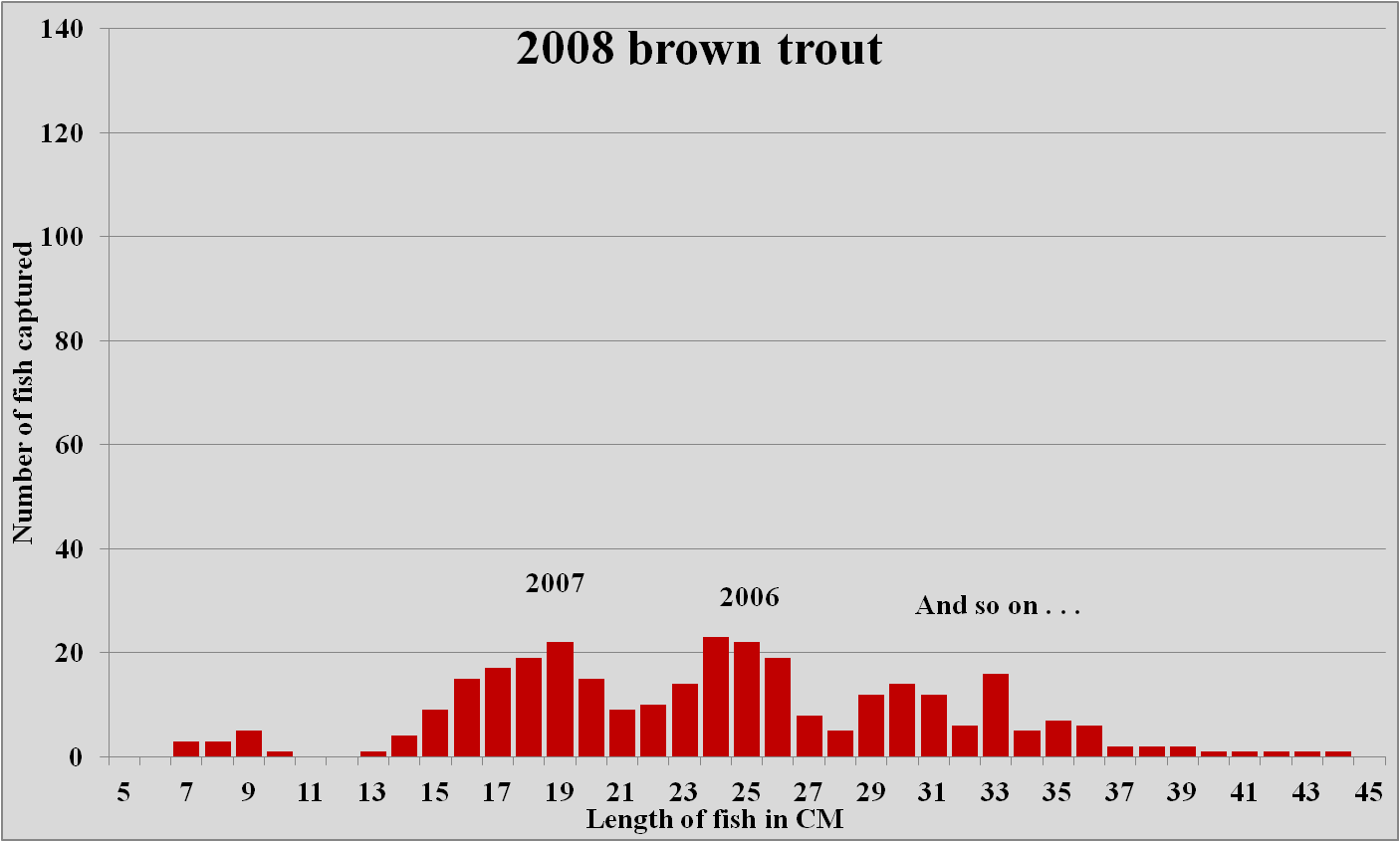
You can see that in 2008, the sample revealed an extremely weak - almost nonexistent - year class of fish born that year, and a pretty weak 2007 year class as well. A comparison of the 2007 year class with the 2011 year class shows that the 2011 fish were roughly three times as abundant as the 2007 fish. The population estimate in 2008 for larger fish was better, at 25 fish per acre >14", but there were not enough fish in the smaller age classes to replace the larger fish as they cycled out of the population. Hence, what we're seeing now: the lowest densities of brown trout >14" ever recorded on this reach, and on the Parshall-Sunset reach also. One reason I'm confident in this assessment is that I can show you the exact same thing in the data from down on that section. You can see it in the report that I linked above - look at the histogram from 2009. That reflects the weak year classes of that period. Any time you have fewer small fish than large fish in a population, your numbers of large fish can obviously do nothing but decline over time. Also, by looking at the graphs you can now see why in 2012, the estimates for fish per mile and total biomass increased (due to the contribution of large numbers of small fish), while at the same time the density of quality fish dropped by half.
So, the short-term response to some of your observations is that we are just now experiencing the lull in large fish recruitment that was created by poor survival in the 2007 and 2008 year classes. You're definitely not the only one I've heard from who has noticed that the fishing over the past year was relatively poor, and I believe this is why. Luckily, as I've shown, we have strong year classes working their way up now, and over the next year or two I think that we can at least expect to get back into that range of 25 or so fish per acre >14". Not to mention that we are on the verge of seeing a significant comeback of wild rainbows, as you can see in the Parshall-Sunset report.
The big picture aspect of some of the things you mentioned, is a little bleaker story. We know beyond the shadow of a doubt that the aquatic invertebrate community has changed on this portion of the Colorado River over the past couple of decades. That has been documented by countless anglers' anecdotal observations, as well as scientifically documented by one of our researchers, Barry Nehring, in this report:
http://wildlife.state.co.us/SiteCollectionDocuments/DOW/Research/Aquatic/pdf/Publications/CORiverAquaticResourcesInvestigations2011.pdf
This study has proven to be very valuable as we have entered into conversations with water users regarding mitigation and enhancement ideas for the river as an aspect of plans to divert more water. Those negotiations all take place above my head -- mostly to my great relief -- and in a somewhat politicized arena. But the fact that we've been able to document these things has set the stage for what I think will be some generous mitigation measures that would not have otherwise been possible. Hopefully things will be looking up on the Colorado as these projects take shape over the next several years.
So, the short-term response to some of your observations is that we are just now experiencing the lull in large fish recruitment that was created by poor survival in the 2007 and 2008 year classes. You're definitely not the only one I've heard from who has noticed that the fishing over the past year was relatively poor, and I believe this is why. Luckily, as I've shown, we have strong year classes working their way up now, and over the next year or two I think that we can at least expect to get back into that range of 25 or so fish per acre >14". Not to mention that we are on the verge of seeing a significant comeback of wild rainbows, as you can see in the Parshall-Sunset report.
The big picture aspect of some of the things you mentioned, is a little bleaker story. We know beyond the shadow of a doubt that the aquatic invertebrate community has changed on this portion of the Colorado River over the past couple of decades. That has been documented by countless anglers' anecdotal observations, as well as scientifically documented by one of our researchers, Barry Nehring, in this report:
http://wildlife.state.co.us/SiteCollectionDocuments/DOW/Research/Aquatic/pdf/Publications/CORiverAquaticResourcesInvestigations2011.pdf
This study has proven to be very valuable as we have entered into conversations with water users regarding mitigation and enhancement ideas for the river as an aspect of plans to divert more water. Those negotiations all take place above my head -- mostly to my great relief -- and in a somewhat politicized arena. But the fact that we've been able to document these things has set the stage for what I think will be some generous mitigation measures that would not have otherwise been possible. Hopefully things will be looking up on the Colorado as these projects take shape over the next several years.
Subscribe to:
Posts (Atom)